The ETF-ification of DeFi
The ETF-ification of DeFi
This article is also published on Paragraph and X.
DeFi Today
I love Morpho Blue. It’s the most elegant codebase DeFi has produced. That's why I've been shilling Morpho so hard since the launch in 2023, that's also why I’ve spent the past year building @monarchlend - an interface and toolkits that lets users bypass vaults and supply directly to individual Morpho markets.
The reason is simple: I don’t trust curators. Their incentives are misaligned with mine as a depositor, and conceptually, intermediaries are exactly what DeFi set out to eliminate. Recent discussions around xUSD, mHYPER and constant drama with Morpho vault curators makes this clear.
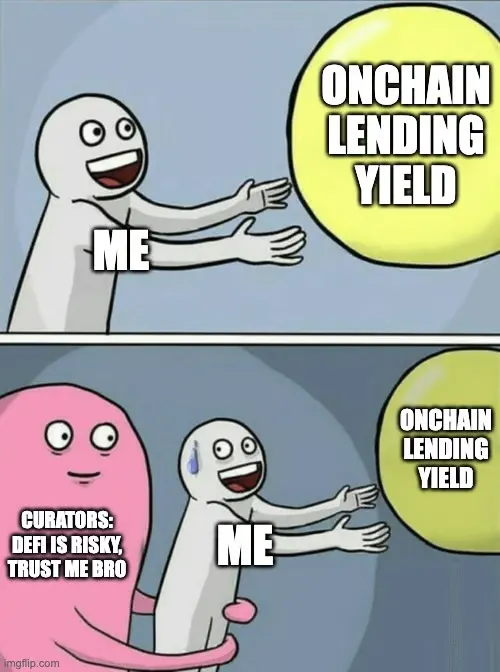
Managed vaults make sense. But it’s wrong that over 90 % of deposits now flow through them. It’s like we built a global, peer-to-peer stock exchange, and 90 % of participants only buy ETFs. Its looks simpler — but it kills the real market mechanism.
Here's why the curator meta is not the future.
Incentives Drift, and Risk Follows
The Principle Agent Problem:
The person acting on your behalf doesn’t necessarily act in your best interest.
TVL can also become a marketing metric for “safety,” and safety attracts even more TVL. Smaller vaults chase yield to compete—often through reward farming or side deals.
The xUSD drama this week — where curators trusted a 4× leveraged “stablecoin”—shows how easily “managed” risk becomes un-managed exposure. Aa @definikola pointed out, the risk curators today "chases marginal APY boosts to increase your TVL at a cost of listing risky/self-backed collateral"
This isn’t about bad actors. It’s structure. When managers take risk with other people’s capital, upside is private and downside is socialized. That’s moral hazard, the quiet engine behind every over-levered blow-up in 2008. Heads, they win; tails, depositors lose.

And because curation is rewarded by size, not prudence, we now see what summarized perfectly: “Yield farming has turned into gated deals and incestuous cronyism… curators-tokenized yield funds favor the protocols that give them TVL.”
Again, curators are simply playing a different game. Their KPIs are growth and visibility, not depositor risk-adjusted returns.
Maps, Territories, and the Illusion of Safety
Why risk curation is not the future for DeFi.
I recently learned a new concept: The Map-Territory Relation: Polish-American philosopher Alfred Korzybski said, “The map is not the territory.” -- the abstraction is not the reality.
In DeFi, curators draw maps—risk frameworks, collateral tiers, safety scores. Over time, those maps become the reality everyone references.
New vaults use existing allocations as validation: “if other curators listed it, it must be safe.” Projects learn to optimize for the map—appearing Tier A instead of being sound. Soon, vaults are referencing vaults, and the ecosystem starts orbiting its own abstractions. This is why "modeling risk" can never be perfect, the more we model risks, the less we measure it.

That’s not risk management; that’s meta-risk creation. The moment everyone prices safety by proxy, information decays. Some markets never get funded because they’re too small to fit a curator’s "model", while others get over-allocated because one vault made a convenient assumption.
Curators manage uncertainty for many, but with less information than any single user has about their own preferences. They’re forced to generalize—to guess a “median” risk appetite that doesn’t exist.
It’s like drawing a world map without ever visiting the countries, and then telling the locals to navigate by it. In reality, the locals—the actual market participants—often know the terrain far better. DeFi enables (and should encourages) everyone to draw their own paths, not just follow someone else’s abstraction.
The Way Out
Vaults are useful. They batch transactions, simplify UX for beginners, and is extremely helpful when it comes to onboarding tradfi. But they should not be the default for users who ask for "DeFi".
Going back to the ETF metaphor: we built a decentralized trading network, then told everyone not to trade. We tell users to buy the index—to trust the fund manager.
Direct allocation isn’t harder. When you supply to a lending market, you only ask: Do I trust this collateral and this oracle? Is this APY worth it?
Managing your own assets is fundamentally different from managing funds for others. You don’t need a curator’s toolkit or models to average everyone’s preferences — you only need clarity on your own.When you participate directly, the road ahead is often clearer than the map drawn for you.
That’s why I've been working on Monarch for so long, and also why I'm launching Monarch Autovaults— tools that let you define your own boundaries: total collateral exposure, per-market caps (the Morpho Vault V2 enables this btw), and customizable settings like whether to prioritize yield or availabillity.
It’s the exact same vault infrastructure all curators use, but you own the map.
The more people supply directly, the healthier the market becomes. Each decision adds signal; each deposit restores discovery. Vaults will remain part of the stack, but they shouldn’t define it.
DeFi was never about finding better managers. It was about removing the need for them.
We built a decentralized market. Let’s stop buying the ETFs.